$44.95
Add to Cart
The Harold Lloyd Comedy Collection DVD Set - Volumes 1, 2 & 3!
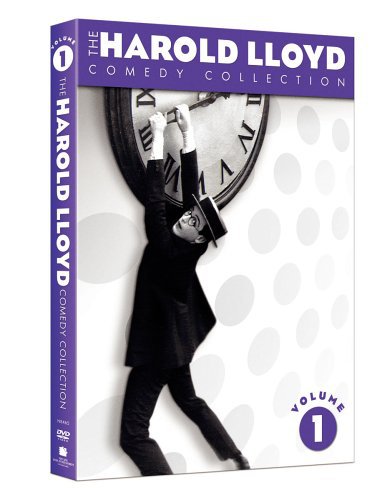
This is a set of 3 - The Harold Lloyd Comedy Collection DVD's in like new condition!
Volume 1: Harold Lloyd's place as the "third genius" of silent comedy (with Chaplin and Keaton) should be cemented by the release of his best work in splendid prints on DVD. The Harold Lloyd Collection, Vol. 1, a two-disc set, leads off with the most famous of Lloyd's pictures, the 1923 "thrill" comedy Safety Last. The bespectacled Mr. Lloyd found his spot in comedy by playing the persona seen here: an optimistic go-getter, energetic but not particularly remarkable, who perseveres as he moves up the ladder. In Safety Last, he really moves up: Harold is a department store clerk who concocts a publicity scheme for his store, which results in a climactic, hair-raising ascent up the outside of the building (at one point hanging from the hands of a huge clock). The ingenious shooting of the sequence--no rear projection of digital effects here--made audiences gasp at Lloyd's apparent peril. (His acrobatic stunts are all the more remarkable when you realize that Lloyd lost two fingers on his right hand in a 1919 publicity stunt involving a prop bomb).
There is at least one other masterpiece on Vol. 1, the wonderful Girl Shy (1924), in which Harold is a small-time tailor's apprentice who can't speak to women but nevertheless has penned a how-to book entitled The Secret of Making Love. A stream of terrific gags (look for how Lloyd employs a dog on a train) and a nice love story blend smoothly, and the movie has an extended chase sequence using car, horse, streetcar, motorcycle, and firetruck. There's also the 1923 Why Worry?, Lloyd's last feature with longtime producer Hal Roach, which suffers just a bit with its odd milieu (tropical island beset by revolutionaries) but has some hilariously weird routines built around compact Harold and the giant John Aasen (8 feet, 9 inches).
A trio of shorter films are included, including 1920's From Hand to Mouth, which puts Lloyd in a Chaplinesque down-and-out situation. A new nine-minute featurette, Harold's Hollywood: Then and Now, visits Hollywood location sites from Lloyd films. Indeed, one of the pleasures of watching Lloyd's films is his outdoorsy use of 1920s L.A. locations and outmoded vehicles such as streetcars. Two Paramount sound features are also here, the oddball Cat's Paw and the entertaining The Milky Way. The latter has Harold as a milkman who boxes his way to a title fight; the comedian's spirit jibes well with the breezy direction of Leo McCarey.
Special features
Includes: Safety Last!, An Eastern Westerner, Ask Father, Girl Shy with alt. organ score, From Hand to Mouth, The Cat's-Paw, The Milky Way, Why Worry?
Commentary by critic Leonard Maltin & director Rich Correll on Safety Last!
Featurette: "Harold's Hollywood: Then and Now"
Production galleries
Volume 2
The second volume of the definitive Harold Lloyd collection in no way plays second banana to Vol. 1. This splendid two-disc set might be the best of the three Lloyd volumes, and on its own serves as a worthy introduction to one of silent cinema's comic geniuses. It has three of Lloyd's finest features, Grandma's Boy, The Freshman, and The Kid Brother, one of his funniest sound features, and a smorgasbord of topnotch shorter films.
The Freshman (1925) presents Lloyd's successful screen persona fully realized: hopeful, plucky, a regular guy with high ambitions. He plays a college plebe whose ridiculous ideas about making himself ingratiating to others (including hilariously inapt jig during a handshake) makes him the laughingstock of the campus. The movie concludes with a justifiably famous football sequence, later excerpted by Preston Sturges for his Lloyd-starring comedy, The Sin of Harold Diddlebock. The Kid Brother (1927) is Harold as the weak link in the tough Hickory family, while Dr. Jack (1922) casts him as a country doctor whose ordinary ways prove sharper than they seem (his co-star, as in some other films here, is future wife Mildred Davis). In Grandma's Boy (1922) Lloyd plays a small-town fellow who lives with his frisky grandmother; convinced of his own cowardice, he yearns to compete for the hand of a pretty girl. His courtly call to the girl's home is the occasion for uproarious battle with a ridiculous "formal" suit, mothballs, and a litter of kittens attracted by the goose grease on his shoes. There's also a long (and quite funny) flashback to Lloyd's ancestor, tangled in a Civil War fracas.
The short films include Bumping Into Broadway (1919), which gives an early glimpse at Lloyd's athleticism, and Billy Blazes, Esq. (1919), which puts Lloyd in the Old West. The gem is High and Dizzy (1920), a warm-up for his classic Safety Last (on Vol. 1), which has a great sequence with Lloyd tipsily navigating a ledge on a high building. Feet First (1930), Lloyd's second talking picture, has Harold as an upwardly-striving shoe salesman trying to finesse his way up the ladder. Some good shipboard sequences in the middle of this one, but the main drawing card is a throwback: Lloyd re-visiting the Safety Last hanging-from-a-building sequence, but this time working every variation known to slapstick. It's really funny, and shows his physical dexterity to be undiminished (the bit is marred only by the insensitive racial jokes at the expense of actor Willie Best, who is billed under his wince-worthy performing name, Sleep 'n Eat). Commentaries on two films and lots of production stills round out the package, along with a short doc about music for silent slapstick comedy. --Robert Horton
Special features
Includes: The Kid Brother, Bumping Into Broadway, The Freshman, Billy Blazes Esq. with alt. organ score, Dr. Jack, Feet First, Grandma's Boy, Now or Never, High and Dizzy
Commentary by Leonard Maltin, director Richard Correll, and film historian Richard W. Bann on The Freshman
Commentary by Harold Lloyd's granddaughter Suzanne Lloyd, author Annette D'Agostino Lloyd, and Richard Correll on The Kid Brother
Production galleries
Featurette: "Scoring for Comedy"
Volume 3
The third volume in the Harold Lloyd Comedy Collection is close to the standard of excellence set by the first two installments of this essential series. Actually, Lloyd's 1928 Speedy, his last silent picture, would justify this two-disc set by itself. The film packs as many great gags per minute as any Lloyd film, and it also has one of his sweetest love stories (a courtship scene in the back of a moving van, with Harold rearranging the furniture to approximate a cozy living room). But the film is also notable for its extensive location shooting in New York City. There's a sequence involving Babe Ruth (as himself) in the back of Harold's speeding taxi, and the filmmakers also captured one of the Bambino's record-setting 60 home runs from the 1927 campaign. The sequences shot at Coney Island, with some wonderfully hair-raising (and understandably obsolete) rides is gorgeous and historically valuable. Meanwhile, check out the stunning horse-drawn streetcar accident caught on film, and then listen to the commentary for an explanation of how it happened and was incorporated into the storyline.
Hot Water (1924) also goes into the time capsule of great Lloyd features, even if it feels like a handful of shorter films shoehorned together. This one gets its charm from the basic domestic situation (Harold takes the family out for a spin in the new car, faces down his meddling mother-in-law). It turns to haunted-house jokes toward the end, which gives Lloyd a chance to do his electric-hair bit, a familiar gag from his films. Like Hot Water, For Heaven's Sake (1926) is an hour long; this funny one casts Lloyd as a rich twit who takes up with a girl whose father runs a homeless mission. It has a great love scene in a slum (the moon in the background turns out to be a neon sign) and another hair-raising chase. Just how did they get the shot of Lloyd on a speeding bus heading through an intersection with two trains crossing?
There's one talking picture, Movie Crazy (1932), a somewhat routine film from Lloyd's increasingly unsuccessful stint in talkies. He plays a young rube who arrives in Hollywood certain he'll be the next "new face." The silent shorts, of which there are many here, are better. Check out Haunted Spooks from 1920, which has its share of good jokes but which is also fascinating for its place in Lloyd's career. He suffered an off-set accident midway through shooting, costing him the thumb and forefinger of his right hand; after a hiatus, he completed shooting with a prosthetic glove (which he used in films thereafter). A heartfelt 15-minute documentary on Lloyd's palatial L.A. estate, Greenacres, uses copious home-movie footage to show the marvelous place and give a hint of Lloyd's homey, likable personality. --Robert Horton
Special features
Includes: Speedy, Never Weaken, Haunted Spooks, Hot Water with alternate organ score, Movie Crazy, Get Out and Get Under, For Heaven's Sake, Number Please?, A Sailor-Made Man, Among Those Present, I Do
Commentary by Harold Lloyd's granddaughter, author Annette D'Agostino Lloyd, and director Richard Correll on Speedy and Haunted Spooks
Featurette: "Greenacres"
Production galleries
Just as pictured.
x.xx-1.14-CHEM
Volume 1: Harold Lloyd's place as the "third genius" of silent comedy (with Chaplin and Keaton) should be cemented by the release of his best work in splendid prints on DVD. The Harold Lloyd Collection, Vol. 1, a two-disc set, leads off with the most famous of Lloyd's pictures, the 1923 "thrill" comedy Safety Last. The bespectacled Mr. Lloyd found his spot in comedy by playing the persona seen here: an optimistic go-getter, energetic but not particularly remarkable, who perseveres as he moves up the ladder. In Safety Last, he really moves up: Harold is a department store clerk who concocts a publicity scheme for his store, which results in a climactic, hair-raising ascent up the outside of the building (at one point hanging from the hands of a huge clock). The ingenious shooting of the sequence--no rear projection of digital effects here--made audiences gasp at Lloyd's apparent peril. (His acrobatic stunts are all the more remarkable when you realize that Lloyd lost two fingers on his right hand in a 1919 publicity stunt involving a prop bomb).
There is at least one other masterpiece on Vol. 1, the wonderful Girl Shy (1924), in which Harold is a small-time tailor's apprentice who can't speak to women but nevertheless has penned a how-to book entitled The Secret of Making Love. A stream of terrific gags (look for how Lloyd employs a dog on a train) and a nice love story blend smoothly, and the movie has an extended chase sequence using car, horse, streetcar, motorcycle, and firetruck. There's also the 1923 Why Worry?, Lloyd's last feature with longtime producer Hal Roach, which suffers just a bit with its odd milieu (tropical island beset by revolutionaries) but has some hilariously weird routines built around compact Harold and the giant John Aasen (8 feet, 9 inches).
A trio of shorter films are included, including 1920's From Hand to Mouth, which puts Lloyd in a Chaplinesque down-and-out situation. A new nine-minute featurette, Harold's Hollywood: Then and Now, visits Hollywood location sites from Lloyd films. Indeed, one of the pleasures of watching Lloyd's films is his outdoorsy use of 1920s L.A. locations and outmoded vehicles such as streetcars. Two Paramount sound features are also here, the oddball Cat's Paw and the entertaining The Milky Way. The latter has Harold as a milkman who boxes his way to a title fight; the comedian's spirit jibes well with the breezy direction of Leo McCarey.
Special features
Includes: Safety Last!, An Eastern Westerner, Ask Father, Girl Shy with alt. organ score, From Hand to Mouth, The Cat's-Paw, The Milky Way, Why Worry?
Commentary by critic Leonard Maltin & director Rich Correll on Safety Last!
Featurette: "Harold's Hollywood: Then and Now"
Production galleries
Volume 2
The second volume of the definitive Harold Lloyd collection in no way plays second banana to Vol. 1. This splendid two-disc set might be the best of the three Lloyd volumes, and on its own serves as a worthy introduction to one of silent cinema's comic geniuses. It has three of Lloyd's finest features, Grandma's Boy, The Freshman, and The Kid Brother, one of his funniest sound features, and a smorgasbord of topnotch shorter films.
The Freshman (1925) presents Lloyd's successful screen persona fully realized: hopeful, plucky, a regular guy with high ambitions. He plays a college plebe whose ridiculous ideas about making himself ingratiating to others (including hilariously inapt jig during a handshake) makes him the laughingstock of the campus. The movie concludes with a justifiably famous football sequence, later excerpted by Preston Sturges for his Lloyd-starring comedy, The Sin of Harold Diddlebock. The Kid Brother (1927) is Harold as the weak link in the tough Hickory family, while Dr. Jack (1922) casts him as a country doctor whose ordinary ways prove sharper than they seem (his co-star, as in some other films here, is future wife Mildred Davis). In Grandma's Boy (1922) Lloyd plays a small-town fellow who lives with his frisky grandmother; convinced of his own cowardice, he yearns to compete for the hand of a pretty girl. His courtly call to the girl's home is the occasion for uproarious battle with a ridiculous "formal" suit, mothballs, and a litter of kittens attracted by the goose grease on his shoes. There's also a long (and quite funny) flashback to Lloyd's ancestor, tangled in a Civil War fracas.
The short films include Bumping Into Broadway (1919), which gives an early glimpse at Lloyd's athleticism, and Billy Blazes, Esq. (1919), which puts Lloyd in the Old West. The gem is High and Dizzy (1920), a warm-up for his classic Safety Last (on Vol. 1), which has a great sequence with Lloyd tipsily navigating a ledge on a high building. Feet First (1930), Lloyd's second talking picture, has Harold as an upwardly-striving shoe salesman trying to finesse his way up the ladder. Some good shipboard sequences in the middle of this one, but the main drawing card is a throwback: Lloyd re-visiting the Safety Last hanging-from-a-building sequence, but this time working every variation known to slapstick. It's really funny, and shows his physical dexterity to be undiminished (the bit is marred only by the insensitive racial jokes at the expense of actor Willie Best, who is billed under his wince-worthy performing name, Sleep 'n Eat). Commentaries on two films and lots of production stills round out the package, along with a short doc about music for silent slapstick comedy. --Robert Horton
Special features
Includes: The Kid Brother, Bumping Into Broadway, The Freshman, Billy Blazes Esq. with alt. organ score, Dr. Jack, Feet First, Grandma's Boy, Now or Never, High and Dizzy
Commentary by Leonard Maltin, director Richard Correll, and film historian Richard W. Bann on The Freshman
Commentary by Harold Lloyd's granddaughter Suzanne Lloyd, author Annette D'Agostino Lloyd, and Richard Correll on The Kid Brother
Production galleries
Featurette: "Scoring for Comedy"
Volume 3
The third volume in the Harold Lloyd Comedy Collection is close to the standard of excellence set by the first two installments of this essential series. Actually, Lloyd's 1928 Speedy, his last silent picture, would justify this two-disc set by itself. The film packs as many great gags per minute as any Lloyd film, and it also has one of his sweetest love stories (a courtship scene in the back of a moving van, with Harold rearranging the furniture to approximate a cozy living room). But the film is also notable for its extensive location shooting in New York City. There's a sequence involving Babe Ruth (as himself) in the back of Harold's speeding taxi, and the filmmakers also captured one of the Bambino's record-setting 60 home runs from the 1927 campaign. The sequences shot at Coney Island, with some wonderfully hair-raising (and understandably obsolete) rides is gorgeous and historically valuable. Meanwhile, check out the stunning horse-drawn streetcar accident caught on film, and then listen to the commentary for an explanation of how it happened and was incorporated into the storyline.
Hot Water (1924) also goes into the time capsule of great Lloyd features, even if it feels like a handful of shorter films shoehorned together. This one gets its charm from the basic domestic situation (Harold takes the family out for a spin in the new car, faces down his meddling mother-in-law). It turns to haunted-house jokes toward the end, which gives Lloyd a chance to do his electric-hair bit, a familiar gag from his films. Like Hot Water, For Heaven's Sake (1926) is an hour long; this funny one casts Lloyd as a rich twit who takes up with a girl whose father runs a homeless mission. It has a great love scene in a slum (the moon in the background turns out to be a neon sign) and another hair-raising chase. Just how did they get the shot of Lloyd on a speeding bus heading through an intersection with two trains crossing?
There's one talking picture, Movie Crazy (1932), a somewhat routine film from Lloyd's increasingly unsuccessful stint in talkies. He plays a young rube who arrives in Hollywood certain he'll be the next "new face." The silent shorts, of which there are many here, are better. Check out Haunted Spooks from 1920, which has its share of good jokes but which is also fascinating for its place in Lloyd's career. He suffered an off-set accident midway through shooting, costing him the thumb and forefinger of his right hand; after a hiatus, he completed shooting with a prosthetic glove (which he used in films thereafter). A heartfelt 15-minute documentary on Lloyd's palatial L.A. estate, Greenacres, uses copious home-movie footage to show the marvelous place and give a hint of Lloyd's homey, likable personality. --Robert Horton
Special features
Includes: Speedy, Never Weaken, Haunted Spooks, Hot Water with alternate organ score, Movie Crazy, Get Out and Get Under, For Heaven's Sake, Number Please?, A Sailor-Made Man, Among Those Present, I Do
Commentary by Harold Lloyd's granddaughter, author Annette D'Agostino Lloyd, and director Richard Correll on Speedy and Haunted Spooks
Featurette: "Greenacres"
Production galleries
Just as pictured.
x.xx-1.14-CHEM
Other Products from magicmedia (View All)
-
$14.95
-
$9.95
-
$24.95
-
$14.95
-
$9.95
-
$24.95
-
$74.95

-
$44.95
-
$9.95
-
$24.95